Menu

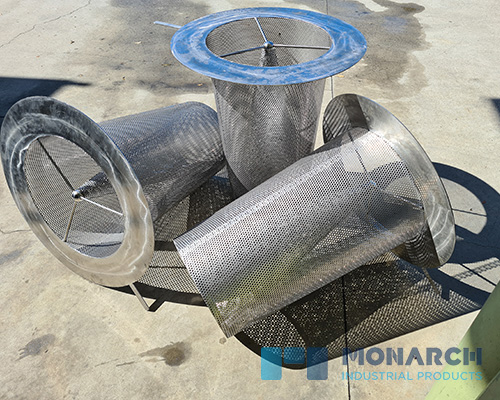


Inverted Cone Sections
Compact temporary strainer sections with increased surface area
Manufactured in Australia by Monarch
Monarch manufactures inverted cone sections in Australia for temporary strainer and custom filtration applications where increased screen area is required within limited installation space. By reversing the cone profile, this design can provide greater gross filtration surface area than a conventional cone arrangement while helping maintain a compact overall assembly length.
Inverted cone sections are commonly considered where pipeline start-up, commissioning, or equipment protection duties call for a temporary element that can fit within existing pipework and flange spacings. The added available surface area can assist in reducing face velocity through the perforated plate or mesh media, which can help improve dirt-holding capacity and support more practical operating performance during short-term service.
Monarch can manufacture inverted cone sections to suit customer pipe sizes, flange standards, length restrictions, and required open area ratios. Units can be produced in perforated plate only or with perforated support material backed by wire mesh where finer retention is required. Depending on the duty, designs may also incorporate internal or external reinforcing to improve strength and dimensional stability.
Our Brisbane workshop supports custom manufacture with in-house CNC plasma cutting and general engineering capability, allowing us to respond to urgent shutdown, commissioning, and replacement requirements. We work with customers to produce inverted cone sections suited to the application, whether for coarse start-up debris, equipment protection, or a more specialised temporary straining duty.
Monarch’s inverted cone sections are made to order for industrial applications across water, process, oil and gas, chemical, mining, utilities, and general plant services where a compact temporary strainer solution is required.
Typical design considerations include:
- line size and flange standard
- required removal size
- open area ratio and pressure loss considerations
- perforated plate thickness and support requirements
- reinforcement for differential pressure loading
- material selection to suit service conditions
Advantages:
- increased gross surface area in limited length
- suitable where spool length is restricted
- can improve debris-holding capacity during commissioning
- can be designed with reinforcement for demanding service
Monarch Asia Pacific Pty Ltd
Trading as Monarch Industrial Products
ABN 60 141 555 688
Unit 3, 8 Bult Drive, Brendale, QLD 4500
AUSTRALIA
Phone: +61 (0) 7 3889 9949



Monarch Asia Pacific Pty Ltd, © 2026 All Rights Reserved
Release: 26:6:0