Menu

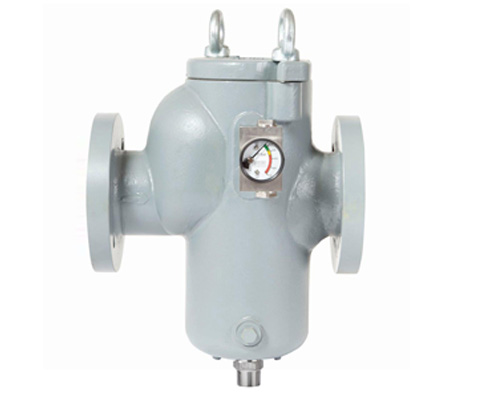


Flushing Strainers
Flushing Basket Strainers are a modified simplex basket strainer designed to remove collected debris quickly through a bottom drain connection—without opening the strainer for routine cleaning. With the drain valve closed, the strainer operates like a standard simplex unit. When the valve is opened, retained solids are purged from the basket and discharged through the drain port in a rapid “flush” action.
Flush performance is driven by the available differential pressure (ΔP) across the strainer and the pressure at the drain outlet (often atmospheric). Results also depend on the type of solids being captured. For hard, non-deformable particles such as pipe scale or grit that don’t embed into the screen, flushing basket strainers offer a cost-effective way to reduce maintenance time and labour, while maintaining the lower pressure drop benefits of a basket-style strainer.
Simplex Basket Strainer with Flush (Back-Flush) Capability
Similar to the blowdown feature found on a Y-strainer, a flushing (back-flush) simplex basket strainer is a variation of a standard simplex basket strainer designed to quickly purge collected debris without dismantling the housing. It uses a special “bottomless” basket that allows accumulated particles to discharge through the drain port when a flush valve is opened.
Manual or Actuated Flush Valves
We can supply the flushing strainer with either a manual drain valve or an actuated valve assembly. The actual debris discharge from the basket typically takes 1–2 seconds, however with an actuated valve the overall “flush cycle” is governed by the actuator travel time—commonly 18 to 30 seconds from closed → open → closed.
Automation Considerations
While automatic flushing can be attractive, it often introduces additional control requirements. In many applications, an automated flush system will need a PLC (programmable logic controller) to:
- trigger flushing on a timer or differential pressure (DP) setpoint
- manage upset conditions, such as when debris becomes embedded and the DP does not drop sufficiently after a flush cycle
Because flushing primarily removes loose collected debris (rather than actively cleaning the screen), the added complexity and cost of automation can approach that of a true backwashing strainer system—which does clean the screen. For this reason, automated flushing is typically most practical where debris loading is very light, such as small amounts of hard particulate (e.g., pipe scale) that does not smear or embed into the screen.
Key Advantages
- Cost-effective solution for smaller strainer sizes
- Higher open area than a Y-strainer, resulting in lower pressure drop and less frequent flushing
- Fast, simple debris removal via the drain port (no disassembly for routine purging)
Monarch Asia Pacific Pty Ltd
Trading as Monarch Industrial Products
ABN 60 141 555 688
Unit 3, 8 Bult Drive, Brendale, QLD 4500
AUSTRALIA
Phone: +61 (0) 7 3889 9949


Monarch Asia Pacific Pty Ltd, © 2026 All Rights Reserved
Release: 26:6:0